When two outsiders arrived in Middlesbrough in 1840, they found a small port town of fewer than 400 inhabitants. Within four decades, their partnership had transformed the place into "Ironopolis" — the iron-smelting centre of the world, producing one third of Britain's pig iron.
The Partnership Forms
Henry Bolckow, born in Mecklenburg-Schwerin in northern Germany on 8 December 1806, had established himself as a corn merchant in Newcastle before turning his attention to iron. John Vaughan, born in Worcester on 21 December 1799 to Welsh parents, had worked his way up from scrap mill worker to foreman at the Dowlais Ironworks in South Wales, then served as works manager at Walker-on-Tyne. The two men formed their partnership in 1839 or 1840, combining Bolckow's financial acumen with Vaughan's technical expertise.
Their personal bond proved as strong as their business arrangement. They lived side by side in Cleveland Buildings, roughly 400 yards from their works, and married sisters: Bolckow wed Miriam Hay in 1841, while Vaughan married her sister Eleanor. This closeness would sustain their enterprise for nearly three decades until Vaughan's death.
Founding the Ironworks
In 1841, Bolckow and Vaughan established their first iron foundry and rolling mill on Vulcan Street in Middlesbrough. Initially, they processed pig iron imported from Scotland. The business grew steadily; by 1846, they had built blast furnaces at Witton Park in County Durham, using coal from the colliery there and ironstone from Whitby.
The pivotal moment came on 8 June 1850. Vaughan, accompanied by the mining geologist John Marley, discovered the main seam of Cleveland Ironstone in the Eston Hills. The seam measured over sixteen feet thick — an extraordinary find that would alter Middlesbrough's destiny entirely. Local ironstone meant the entire ironmaking process could now occur on Teesside, eliminating costly imports.
The Birth of Ironopolis
In 1851, Bolckow and Vaughan built the first blast furnace on Teesside at South Bank, Middlesbrough. Production soared; pig iron output increased tenfold between 1851 and 1856. By the mid-1870s, Middlesbrough alone produced one third of the United Kingdom's pig iron, earning the town its "Ironopolis" nickname. The term first appeared in The Northern Echo on 23 February 1870, which noted that "Middlesbrough has sometimes been designated the Ironopolis of the North."
The population explosion matched this industrial growth. Middlesbrough expanded from 40 inhabitants in 1829 to 7,600 in 1851, 19,000 in 1861, 40,000 in 1871, and 90,000 by 1900. Welsh workers flooded into the town, creating communities that shaped its culture for generations.
A Company Without Equal
In 1864, Bolckow, Vaughan and Co. Ltd registered as a limited company with a capital of £2,500,000 — the largest company ever formed anywhere in the world at that time. The firm's holdings stretched across the region: iron mines, collieries, and limestone quarries in Cleveland, County Durham, and Weardale. By 1888, the company owned six of the thirty-six ironstone mines in Cleveland and Whitby, and operated four ironworks with twenty-one of the region's ninety-one blast furnaces.
The workforce grew commensurately. By 1907, Bolckow, Vaughan employed 20,000 men, making it possibly the world's largest producer of pig iron. Even in 1914, the company maintained 18,000 employees.
Civic Leadership
When Middlesbrough received its Royal Charter of Incorporation on 21 January 1853, the new corporation needed a mayor. Henry Bolckow became the town's first Mayor that same year. John Vaughan served as Mayor in 1855. Following the passage of the Reform Bill on 15 August 1867, which made Middlesbrough a parliamentary borough, Bolckow stood for election. On 16 November 1868, he was returned unopposed as the first Member of Parliament for Middlesbrough, serving until his death ten years later.
Bolckow's civic contributions extended beyond political office. In 1868, he spent £20,000 purchasing and landscaping seventy acres to create Albert Park, which opened on 11 August that year. He also funded a school in the St Hilda's district at a cost of £7,000, opened in 1869.
The End of an Era
John Vaughan died on 16 September 1868 in London. Henry Bolckow passed away on 18 June 1878 at Ramsgate, aged seventy-one. Both men are buried at St Cuthbert's Church in Marton, a short distance from where Bolckow had built Marton Hall in 1853.
The company they built outlasted them by decades, though not without difficulty. Poor strategic decisions between 1900 and 1910 delayed the adoption of improved steelmaking technology, and the firm failed to diversify into more profitable steel products. By 1929, the company faced collapse, and in 1931 Dorman Long acquired Bolckow, Vaughan and Co. Ltd.
Lasting Monuments
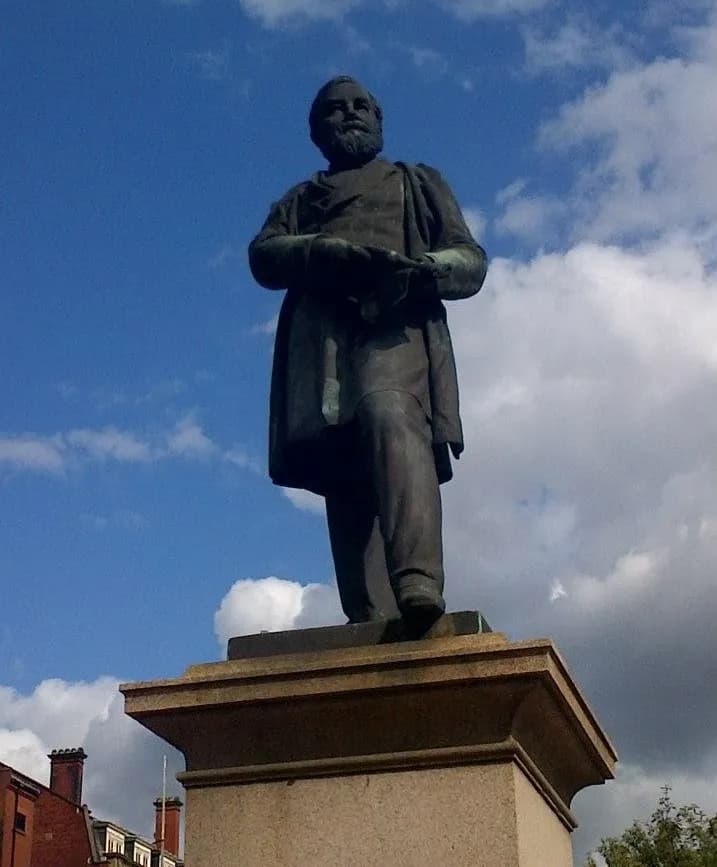
Middlesbrough retains numerous reminders of its founding ironmasters. Bronze statues of both men stand in Exchange Square — Bolckow's by David Watson Stevenson, unveiled in 1881, and Vaughan's by George Anderson Lawson, unveiled on 2 June 1884. Vaughan's statue bears an inscription recording his discovery of ironstone and his role as founder of the town's iron trade. Their graves at St Cuthbert's Churchyard were restored in 2009. Bolckow Street and Vaughan Street in the town centre, along with the more recent Bolckow Square development, ensure their names remain part of daily life in the town they built.
Albert Park, created through Bolckow's generosity, continues to serve the town. Though Marton Hall burned down in 1960, and Gunnergate Hall, built by Vaughan, has also gone, the ironmasters' legacy persists in the very fabric of Middlesbrough — a town built on iron, and built by these two remarkable men.