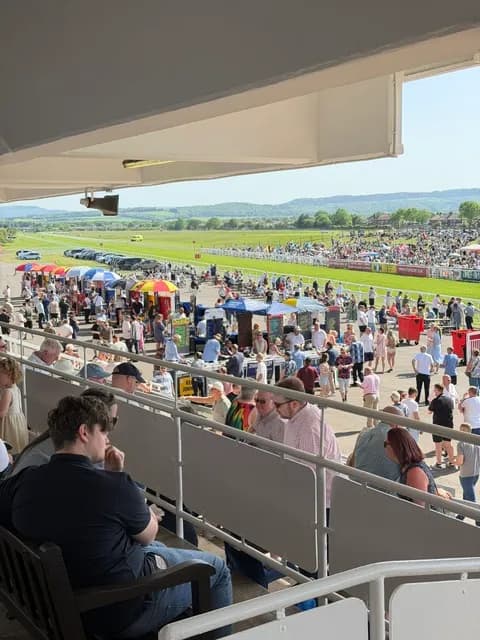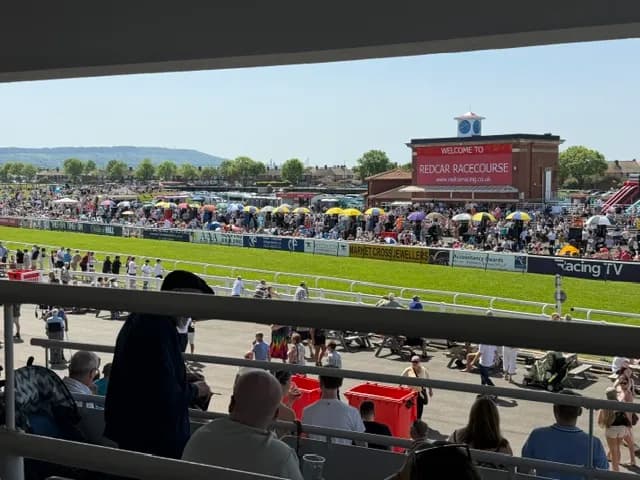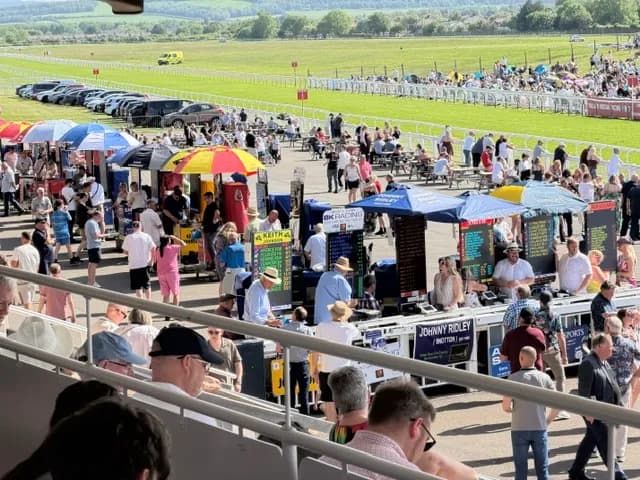
A short train ride down the coast line from Middlesbrough, there is a stretch of turf that racing people across Britain talk about with something close to reverence. Redcar's straight mile is exactly that: a mile of perfectly flat ground with no bend in it, the only straight mile in the country that is both straight and level. On Saturday 3 October it carries the course's biggest prize of the year, and for anyone in Middlesbrough who has never been, there is no better day to start.
October fixtures
Redcar
- Saturday 3 October: the Premier Day, featuring the Two-Year-Old Trophy, the Guisborough Stakes and the final of the Straight Mile Series
- Friday 16 October
- Monday 26 October
Catterick Bridge
- Saturday 17 October: the Catterick Dash meeting, the course's richest race
- Tuesday 27 October: the Flat finale, the last Catterick meeting of the 2026 Flat season
From the sands to the racecourse
Redcar's racing began where you might expect in a seaside town: on the beach. From the early 18th century horses raced on the sands, and the arrangements were improvised to say the least. A local joiner named Adamson put up a grandstand and charged for its use, the judge sat in a bathing van, the stewards watched from a farm wagon and the run-in was marked out with rope. One documented beach fixture tried to settle whether foxhounds or racehorses were faster. The trail laid for the hounds blew into the sea, and the contest collapsed into farce.
A Redcar Race Committee was formed in 1850, and some of its meetings made it into the Racing Calendar, although others were judged too insignificant to record. The end of the beach era came in 1870, when Jockey Club rules required a minimum level of prize money that the sands meetings could not meet. The last race on the beach, the Cleveland Hunt Cup, was won by the jockey John Osborne. Two years later, on 9 August 1872, the present racecourse opened, and the first race on the new ground, the Zetland Welter Handicap Plate, was won by Osborne's father. A grandstand followed in 1876.
The 20th century made Redcar an innovator. Under Major Leslie Petch, who ran the course from 1946 to 1971, Redcar became the first British racecourse to install a timing clock, furlong posts and closed-circuit television. In the 1960s its Vaux Gold Tankard, run from 1959 to 1980, was described as Europe's greatest handicap, and the Andy Capp Handicap, run from 1963 to 1985, was billed as the North's richest handicap for three-year-olds. On 30 July 1980 a horse called Mushref won at Redcar and gave Sheikh Hamdan bin Rashid Al Maktoum his first winner in Britain, the start of one of the great owning careers of modern racing.
The Two-Year-Old Trophy
The race that defines Redcar's autumn was the idea of Lord Zetland, chairman of the racecourse from 1981 to 2018, and it was first run in 1993. It is a Listed race over five furlongs and 217 yards on the straight course, and it has an unusual twist: the weight each juvenile carries is set by its sale price. A cheaply bought youngster gets a weight concession over an expensive yearling, so the race pits the bargain against the blue blood on something like equal terms. Its roll of honour includes Pipalong, trained by Tim Easterby, in 1998, Captain Rio in 2001 and Limato, trained by Henry Candy, in 2014.
The Zetland Gold Cup, founded in 1950, is the course's other famous name, but it belongs to the spring. October is about the juveniles and about the straight.
Catterick Bridge, 1783 and all that
Catterick's first sanctioned meeting was held at Easter 1783, although racing on the site is thought to go back to the mid-17th century. A permanent track was laid in 1813. Its folklore is generous: in 1819 the local innkeeper and owner Thomas Ferguson drove a flock of sheep around the course to trample the snow and save a fixture, and the course accounts once recorded money spent on tar and feathers for welshers, the bookmakers who refused to pay out, before they were thrown into the River Swale. Willie Carson rode his first winner, Pinker's Pond, at Catterick in 1962, and a young Red Rum won there in 1971.
For the seasoned racegoer
Redcar is a left-handed oval of around a mile and six furlongs, flat throughout with relatively tight bends, but the round course is not where the October interest lies. The straight mile is fed by a three-furlong chute and offers no undulations to hide behind, so it rewards a horse that can sustain a gallop rather than one that needs a downhill run to quicken. Fields on the straight can split into groups, and watching where the pace develops is half the puzzle. The Straight Mile Series final on 3 October is the culmination of a season-long programme over this unique strip.
Catterick is a different animal entirely. The Flat track is a left-handed circuit of about a mile and a furlong, sharp and undulating, with a five-furlong chute for sprints. Speed and early position count for a great deal, which is why the Catterick Dash on 17 October is such a fitting showpiece: five frantic furlongs on a course that has little time for hard-luck stories. The finale on 27 October is the course's last Flat meeting of the year, so expect fields of hardened northern handicappers having their final run before winter.
For a first visit
A raceday follows a simple rhythm. Gates open well before the first race, and in the half hour before each contest the runners are led round the parade ring. That is the place to look at the horses up close: a relaxed, well-muscled horse with a shine on its coat is usually a better sign than one that is sweating heavily or fighting its handler. Then the jockeys come out, are legged up and canter to the start.
Courses divide into enclosures with different facilities and views, so check what each ticket includes before you buy. There is no formal dress code in the general areas at either Redcar or Catterick; smart casual is the norm, with a warm coat and sensible shoes for an October afternoon by the North Sea.
Betting can be as simple as a couple of pounds. The Tote pools all the money staked on a race and shares it among the winning tickets, while the bookmakers in the betting ring offer fixed prices that you take at the moment you bet. An each-way bet is two bets in one, half on the horse to win and half on it to finish placed, so it costs twice the stake. Decide on a budget before you arrive, treat it as the cost of the day and never chase losses.
Making a day of it from Middlesbrough
Redcar is the easier trip. Trains run along the coast line from Middlesbrough, and Redcar Central is the nearest station to the course, which sits close to the town centre. Before or after racing, the seafront is the obvious draw: the Redcar Beacon gives a view along the coast, and the Zetland Lifeboat Museum houses the Zetland, built by Henry Greathead in 1802 and the oldest surviving lifeboat in the world, estimated to have saved more than 500 lives. A short drive inland, Kirkleatham Museum is a family-friendly stop, and walkers can follow the sands south towards Saltburn.
Catterick Bridge is further, just off the A1 at Junction 52, about five miles south of Scotch Corner. Make it a North Yorkshire day by heading on to Richmond, a few minutes away, with its Norman castle above the Swale, its cobbled market place and the Georgian Theatre Royal of 1788. Darlington is the nearest railway station to Catterick, with buses running on towards Richmond.
For those staying closer to home, Stewart Park in Marton, with the Captain Cook Birthplace Museum, makes a good family morning before an afternoon at the coast.
Before you go
Check the Redcar and Catterick websites for race times, tickets, the going and any late changes. Flat fixtures in late October can be hit by waterlogging or frost, and an inspection can be called at short notice, so look again on the morning of the meeting.